
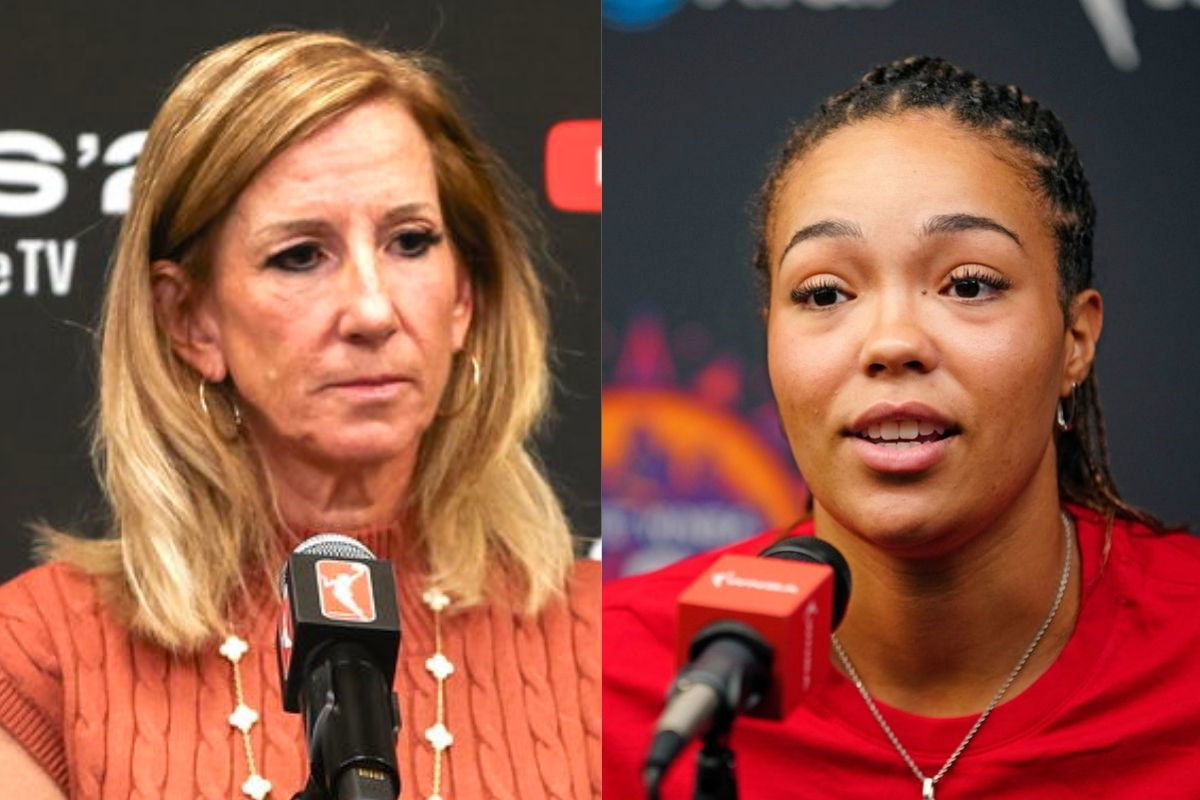
Imago
Credits- Imagn
Imago
Credits- Imagn
The WNBA grabbed headlines with what looked like a breakthrough offer. A $1 million max base salary and a revenue-sharing model designed to help salaries grow year after year. At first, it seemed like the kind of deal the union had been fighting for.
Watch What’s Trending Now!
But, as always, the buried caveats quickly surfaced, and Napheesa Collier made it clear she wasn’t happy with the WNBA CBA proposal.
In true Phee fashion, the Lynx forward voiced her frustration in a subtle but powerful way. She retweeted a post on X from Doug Feinberg, which fans were quick to notice.
ADVERTISEMENT
“Lot of WNBA math has come out in last 24 hours. Not sure how a 1.2 million max salary for a few players and 5 million cap would exactly work with 500k average. Also not sure how making players pay for apartments for six months would equal say going from 60k to 225k minimum salary.”
It was a smart, quiet protest, and a clear sign she wasn’t buying the league’s numbers.
Phee coming back on twitter to retweet this >>>>> pic.twitter.com/Kop570oQLF
— Vanshay Murdock 🎥🎥 (@VanshayM) December 4, 2025
ADVERTISEMENT
She wasn’t the only one. According to The Athletic, even with the league and union extending the WNBA CBA deadline to January 9, there are still “significant gaps” separating both sides in the negotiations.
“I don’t feel like there’s any cultivation of a culture of trust,” WNBPA president Nneka Ogwumike said in an interview with The Athletic. “We don’t feel valued in these talks as they stand today. … I feel like we’ve been heard, but not listened to. And I’m hoping that that changes in this 40-day extension, because what we want to do is get a good deal done.”
ADVERTISEMENT
Before diving into why the players aren’t satisfied with the latest proposal, here’s what the new offer actually includes.
Breaking Down the Current WNBA CBA Offer
According to The Athletic and Front Office Sports, the WNBA’s proposal includes a revenue-sharing system in which a portion of league revenue becomes shareable, with players receiving 50 percent of that amount.
ADVERTISEMENT
The exact formula for determining this revenue hasn’t been clarified, but under the model, max players are projected to earn around $1.2 million in total compensation in the first year, with that number expected to grow over time.
But this revenue system apparently wouldn’t include all revenue streams and would also have certain expenses deducted. According to Front Office Sports, once everything is factored in, the proposed model would leave players with less than 15 percent of the WNBA’s total revenue.
Top Stories
Bills Legend Jim Kelly Announces Final Cancer Update After Years of Battle

Jordan Spieth Breaks Silence on ‘Exemptions’ Backlash After Career Hit All-Time Low

Brian Schottenheimer Blames Locker Room for Loss After Pointing Fingers at Cowboys QB

Calls Mount Against Refs’ Controversial Decision Involving Dak Prescott in Cowboys vs Lions TNF Game

Jared Goff Makes Bold Super Bowl Promise After Lions’ Win

Line Call Drama Interrupts Venus Williams vs Madison Keys Match at Charlotte Invitational

That’s not all. The league has also removed team-issued housing from its proposal. Currently, players receive either team-provided housing or a monthly stipend that varies by market. Last season, it was $1,117 in Las Vegas and $2,647 in New York. The proposal also removes the provision of cars for players.
ADVERTISEMENT
Cathy Engelbert and her team have also proposed a longer season, with a potential start date as early as mid-March and the WNBA Finals wrapping up as late as November 20.
And that is where the problem lies.
ADVERTISEMENT
Why Players Are Rejecting the Latest CBA Proposal
In its latest proposal, the WNBA claims the average salary will be above $500,000. But when you consider that teams can give multiple players a max salary of $1–1.2 million, the rest of the roster is left with almost nothing to work with. Even if you simply divide a $5 million cap across a 12-player roster, the average comes out to just $417,000.
That said, the offer is still much higher than what players make right now. The current supermax is $249,244, and the minimum salary sits at $66,079. But for the players, this isn’t just about bigger paychecks. Their bigger worry is that the proposed model still lets owners keep most of the profits while giving athletes only a small slice of the revenue they help generate.
“We’re saying we bet six years from now we will be much better,” Plum said. “More money, more revenue, more business than right now. Because of that, revenue share is so important. The mistake is trying to offer money up front but not being wise about it and not betting on your long-term vision of revenue share being the ultimate goal.”
ADVERTISEMENT
The players aren’t asking for extra money up front. They know their salaries would grow each season naturally if the league adopted the same revenue-sharing model used in the NBA and NFL. They’re also willing to play a longer season, but only if more games are moved to the back end of the calendar. As things stand, the proposed schedule in the WNBA CBA would overlap with March Madness and Project B, which creates major conflicts.
And then there’s the housing issue. What’s the point of removing the housing allowance if more than half the league still won’t be making the kind of money they need to cover those costs comfortably? Yes, the NBA, NFL, and NHL don’t offer housing stipends, but those leagues also pay their players far more than the WNBA does.
The players have pushed for housing to be included as part of their benefits within the revenue-sharing system, but as things stand, the league isn’t willing to go there.
ADVERTISEMENT
There’s still a lot that needs to fall into place for both sides to reach a CBA agreement. The January 9 deadline is approaching quickly, and no one wants the league to be pushed back any further. But as things stand, a resolution doesn’t seem likely, and the gap between the two parties remains wide.
ADVERTISEMENT
ADVERTISEMENT
ADVERTISEMENT
