
Imago
Image credit: imago
Imago
Image credit: imago
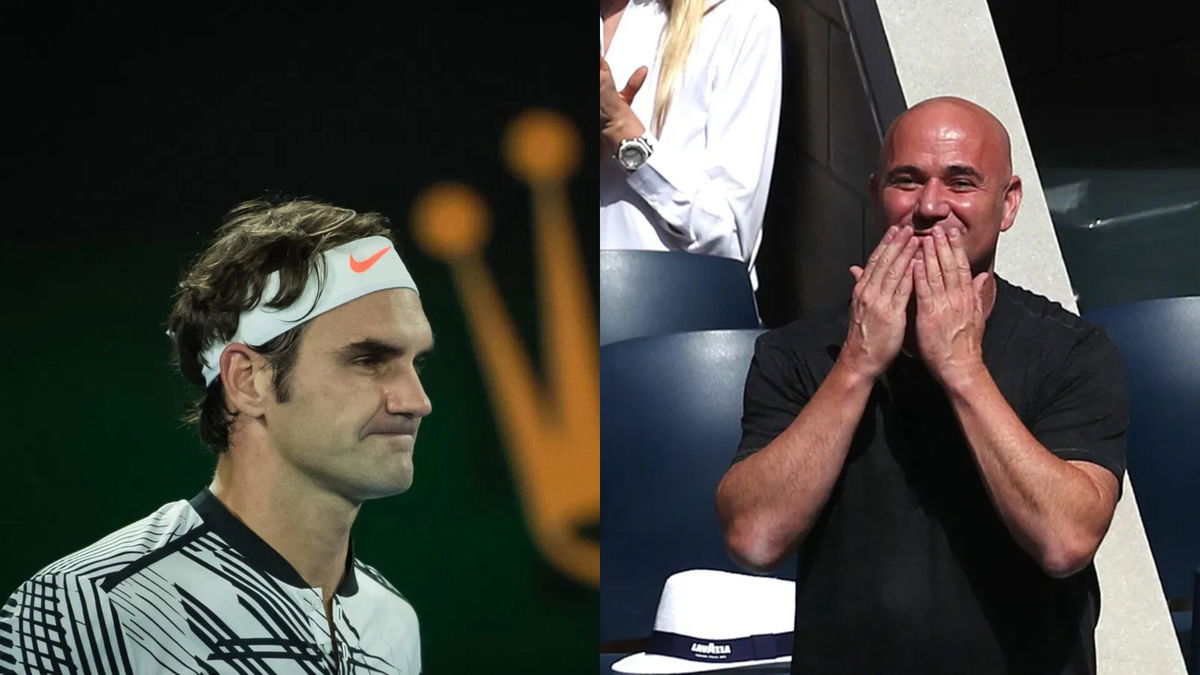
Even in a lighthearted exhibition, one shot from Roger Federer was enough to stop his doubles partner, Andre Agassi, mid-reaction. During theAustralian Open opening ceremony match at Rod Laver Arena, Federer’s instinctive choice to lean on his trademark one-handed backhand prompted an immediate, surprised reaction from Agassi during a friendly match against Pat Rafter and Lleyton Hewitt.
Watch What’s Trending Now!
In one rally, Hewitt served, and Federer stretched to return the ball. The point continued, and Federer floated a beautiful one-handed backhand toward Rafter. Rafter redirected the ball, and Agassi then struck it fiercely toward Hewitt. The Australian could not handle the pace and sent the ball into the net, handing the point to Federer and Agassi.
After the point, Agassi reacted with disbelief. He turned to Federer and said, “What the hell was that? What is this? Stop with this and hit it,” while gesturing for a double-handed backhand. Federer looked confused and replied, “Double-handed?” He briefly tried the motion, then instantly pulled a sour face, clearly regretting it.
ADVERTISEMENT
The look on Federer’s face was easy to understand. His reaction reflected years of trust in a shot he made famous. The one-handed backhand became his signature. Yet it often came at a cost. At Roland Garros, Rafael Nadal’s heavy topspin forced Federer to strike above shoulder height. Those moments exposed the limits of elegance against raw spin.
Everyone disliked that.@rogerfederer‘s reaction to trying a two-handed backhand is gold 😂@wwos • @espn • @tntsports • @wowowtennis • #AO26 pic.twitter.com/DZgZNIwXCr
— #AusOpen (@AustralianOpen) January 17, 2026
As tennis evolved, rallies shifted deeper behind the baseline. Players began trading heavier groundstrokes. Surviving those exchanges with one hand grew harder.
ADVERTISEMENT
For most of the 20th century, the game looked different. Net rushing was common. The one-handed backhand was often sliced or hit flat. It worked perfectly on approach shots and serve returns. In the 21st century, baseline battles intensified. A one-hander now demanded extreme racquet-head speed. Timing had to be perfect. Players needed to match pace and topspin from across the net without margin.
Watching Federer whip through his swing made it look effortless. His motion was fast and graceful. In those moments, Martina Navratilova’s words rang true when she said, “It takes a genius just to execute the shot today.”
ADVERTISEMENT
From a visual standpoint, the effort felt worthwhile. Still, the decline of the one-handed backhand was inevitable. Bigger racquets, slower courts, and grippier strings changed the game. The two-handed backhand offered a simpler solution.
Federer, Stan Wawrinka, Justine Henin, Dominic Thiem, and a few others kept the stroke relevant. Ash Barty also thrived by using her one-handed slice. That shot helped her rise to World No. 1.
The newest contenders tell a different story. Carlos Alcaraz, Jannik Sinner, Iga Swiatek, Aryna Sabalenka, and Daniil Medvedev all rely on two hands. Their backhands reflect modern efficiency.
ADVERTISEMENT
That contrast was not lost on Agassi. Speaking later with Jim Courier, he shifted into analyst mode while reflecting on sharing the court with two former world No. 1s in Federer and Hewitt. Agassi praised Hewitt’s ability to turn defense into offense and thrive in transition, noting how effectively the Australian redirected pace and extended rallies. His tone changed, however, when discussing Federer. “You hit the ball exactly how you want it,” Agassi said, “yet he has all the time in the world. You couldn’t commit. He could change pace or direction, move you north and south, east and west.”
The assessment carried historical weight. Agassi split his hard-court meetings with Hewitt at 4–4 but finished 3–8 against Federer, later acknowledging that facing the Swiss felt like encountering the next generation before the rest of the tour caught up.
With the match undecided, Ash Barty replaced Agassi. The former Australian Open champion received loud cheers. She settled fast. Barty and Federer won 4-2.
ADVERTISEMENT
The closing set also brought a flash of old rivalry humor. After Agassi teased Rafter with a pointed question following a won exchange, Rafter fired back with a blunt, joking insult that sent the crowd into laughter. Even Federer was dragged into the banter, with Rafter quipping that he could have said the same about his partner, but chose restraint. The exchanges underscored how familiar and competitive these matchups once were, even decades removed from their peaks.
Yet, Federer’s one-hander echoed again, even during practice, sounding like a Grand Slam final.
ADVERTISEMENT
Roger Federer revisits Melbourne Park as he delivers a vintage one-handed backhand
Roger Federer made a special return to Melbourne Park ahead of the Australian Open. His presence thrilled fans. It marked his first on-court appearance at the event since retiring from professional tennis. The moment carried nostalgia and excitement.
The Swiss legend stepped onto the court for a practice session. He trained with Casper Ruud, one of the world’s top-ranked players. The session quickly attracted a large crowd and created a warm, electric atmosphere.
Top Stories
Novak Djokovic Addresses Retirement Plans, PTPA Divide and a Worrying Australian Open Build-Up

Ex-Australian Open Champ Has Andre Agassi’s Back After Roger Federer Dominates Fun Showdown

Danielle Collins Under Fire for Controversial Iga Swiatek Prediction at Australian Open: “Never Right About Anything”

Emma Raducanu Breaks Silence Over Scheduling Concerns With a Bold Take: “It’s Easy to Complain”
Although it was only practice, the intensity was real. Federer and Ruud played a friendly tie-break. The rally patterns were sharp, but the mood stayed relaxed and respectful throughout the exchange.
ADVERTISEMENT
Federer used his experience well. He controlled points with smart placement and timing. In the short tie-break, he finished with the better scoreline, showing flashes of the brilliance fans remember so well.
One rally stood out above the rest. Federer returned serve and struck a clean one-handed backhand down the line. The ball clipped the court perfectly for a winner and drew loud applause.
The practice took place on courts where Federer enjoyed enormous success. He won multiple Australian Open titles in Melbourne. His connection with the tournament has always felt deep and personal.
ADVERTISEMENT
And as Federer now bids farewell to the AO stage again, emotions remain strong. Fans cherish these moments. It is uncertain when he will return to the court, but his legacy in Melbourne is secure.
ADVERTISEMENT
ADVERTISEMENT
ADVERTISEMENT
