

Essentials Inside The Story
- Denver Broncos have secured the AFC’s No. 1 seed and a first-round bye with a 14-3 record
- EssentiallySports' exclusive interview with Ed McCaffrey reveals what he thinks about Payton's 2025 roster
- McCaffrey also highlighted a concerning trend for the Broncos in 2025
The Denver Broncos didn’t exactly scrape their way to the AFC’s No. 1 seed. They owned it. 14 regular-season wins, tying a franchise record that hadn’t been touched since 1998, the same year everything ended with a Super Bowl parade. This wasn’t a one-unit story for Denver in 2025. Offense, defense, and special teams all showed up. That’s why, in a chat with EssentiallySports’ Ryan Ward, former Broncos wideout Ed McCaffrey had no hesitation praising Sean Payton’s roster top to bottom.
Watch What’s Trending Now!
“Their (Broncos) defense is, in my opinion, the best in the league,” McCaffrey told Ward. “They’re definitely best in terms of getting after the quarterback. I think they lead the league in sacks by at least seven now, or they had led by up to 12 at one point, but they can really pin their ears and get after the quarterback. They do a decent job of stopping the run. They won a few games without Patrick Surtain, who was last year’s Defensive Player of the Year.”
That praise isn’t just nostalgia talking. Under defensive coordinator Vance Joseph, Denver’s unit backed it up statistically. The Broncos finished the regular season with 68 sacks (most in the NFL) and broke their own single-season franchise record in the process. They came close to the league record, falling just five short, but the bigger takeaway was how those sacks were created.
ADVERTISEMENT
It wasn’t a one-man show. Nik Bonitto led the team with 14 sacks. Jonathon Cooper followed with eight. 8 Broncos players recorded at least four or more sacks, and 12 players at least had 2 sacks. In simple terms, pressure came from everywhere. Quarterbacks rarely had a clean pocket, and offensive lines couldn’t key in on one threat.
That kind of distribution wasn’t accidental. Joseph has been calling defensive plays continuously since 2016, and no coordinator sustains that kind of longevity without a clearly defined identity. His, has always been aggression. Denver blitzed on at least 30 percent of opponent dropbacks this season, extending a nine-year trend under Joseph, and finished among the league’s top five blitzing teams for the eighth straight year. While teams like Seattle and Houston sat near the bottom of the league in blitz rate, Denver leaned fully into pressure as a structural advantage rather than a situational wrinkle.
And while McCaffrey’s praise centered on the pass rush, the run defense held its own. Denver ranked second in rushing yards allowed per game, third in yards per rush, and fourth in rushing touchdowns allowed. That kind of balance, disrupting the pass while staying disciplined against the run, is what separated this defense from the pack. And what made the 2025 version of Joseph’s defense different from earlier iterations was how much it had evolved.
ADVERTISEMENT
When Joseph joined Payton’s staff in 2023, Denver finished 27th in defensive EPA per play and 28th in points per drive allowed, struggling to reconcile Joseph’s blitz-heavy instincts with the Fangio-inspired structures Payton wanted incorporated. The tension came to a head in Week 3 of that season, when Miami scored 70 points in a loss that looked, at the time, like it might end Joseph’s tenure before it began. After that game, Joseph told Payton, “Let me be me, and I promise I’ll help you win.” Two years later, the results speak for themselves.
Still, it wasn’t flawless. The Broncos lost reigning Defensive Player of the Year Patrick Surtain for three games due to a pectoral injury. McCaffrey acknowledged how valuable he is, saying, “I think Vance Joseph is lucky to have a guy like Patrick Surtain.” But even with elite coverage, turnovers were an issue.
ADVERTISEMENT
Denver tied for 26th in takeaways per game (0.8), ranked 18th in interceptions (18), and sat 27th in forced fumbles (26). That’s the gap. They pressured quarterbacks consistently but didn’t always turn disruption into extra possessions. Heading into the postseason, that’s the swing factor, especially now that Surtain is healthy again.
In fact, Denver finished the regular season with just 14 total takeaways, the fifth-lowest mark in the league, and a -3 turnover differential that ranked in the bottom third of the NFL. It’s a notable disconnect for a defense that lived in opposing backfields. The pressure was there, but the ball production rarely followed. That reality has sharpened the postseason focus, particularly after late flashes like Bonitto’s strip sack in Week 18 hinted at what this unit still has the capacity to generate.
That brings us to the offense. And here, McCaffrey’s evaluation was more nuanced.
ADVERTISEMENT
“The key for the Broncos really is getting off to a fast start and getting a lead, but surprisingly, they haven’t been able to do that in most of their games, and they’ve just been phenomenal at coming back in the fourth quarter,” McCaffrey told Ward. “It makes you scratch your head a little bit. It’s like, man, how come you can’t turn it on in the first quarter offensively and build a lead and let your defense go to town.”
On paper, Bo Nix and the offense delivered some impressive late-game heroics. But those comebacks existed because Denver often struggled early. The Broncos ranked 21st in first-quarter points per game at just 4.3. Without those fourth-quarter surges, the No. 1 seed probably doesn’t happen.
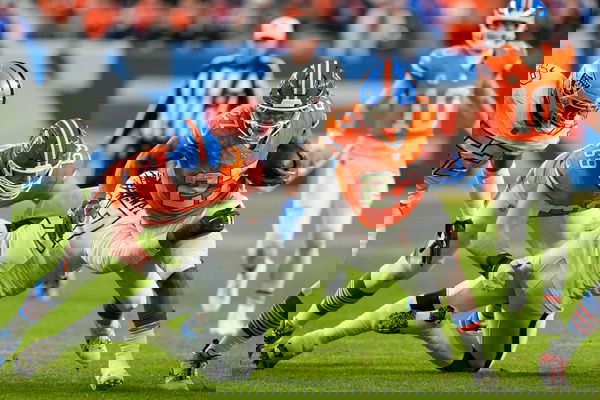
Imago
RECORD DATE NOT STATED 2025 NFL, American Football Herren, USA Regular Season: Las Vegas Raiders at Denver Broncos Denver Broncos running back JK Dobbins 27 makes a rushing attempt during the NFL regular season game versus the Las Vegas Raiders at Empower Field at Mile High in Denver, Colorado on Nov 6, 2025. The Broncos defeated the Raiders 10-7. Max Siker / Image of Denver Colorado United States EDITORIAL USE ONLY Copyright: xImagexofxSportx MaxxSikerx iosphotos385090
The slow starts extended beyond the opening quarter. Denver averaged just 10.9 points per game in the first half across the regular season, a middle-of-the-pack mark that just showed how frequently they entered halftime without control of games they eventually won.
ADVERTISEMENT
Take Week 5 against the Philadelphia Eagles. The final score was 21-17. It looks comfortable. The reality wasn’t. Denver erased a 14-point fourth-quarter deficit to pull it off. Nix finished 24-of-39 for 242 yards and a touchdown, but the urgency came late. Two weeks later, it happened again, only this time it was louder.
Against the New York Giants in Week 7, Denver trailed 19–0 entering the fourth quarter. What followed was a 33-point explosion in the final frame to steal a 33–32 win. Nix threw for 279 yards and two touchdowns, then added 48 rushing yards and two more scores on the ground. Zooming out, the trend becomes clear. Between Weeks 4 and 7, Denver outscored opponents 61–13 in the fourth quarter and won three straight one-score games.
ADVERTISEMENT
They were elite closers. But that also meant they were constantly chasing the game. McCaffrey’s takeaway heading into the postseason is simple: start faster, build a lead, and let the defense dictate terms. Because when Denver plays from ahead with a pass rush this deep and a run defense this disciplined, the margin for error shrinks fast for opponents. Still, none of this has stopped them from winning.
“It doesn’t matter. They’re finding ways to win, and I think the best teams find ways to win. Offense, defense, you need a big play on special teams, you get it, and it just seems like the Broncos are that team this year,” Ed McCaffrey added.
The question now is whether that formula holds against playoff-caliber opponents, especially if the run game doesn’t stabilize. Since J.K. Dobbins went down in Week 10, Denver’s rushing attack has lacked consistency from snap to snap. While RJ Harvey and Jaleel McLaughlin have provided occasional explosive plays, efficiency between the tackles has been uneven, and sustaining drives on the ground has been a challenge. With Dobbins unlikely to be available for the divisional round, the Broncos will need cleaner reads, better lane discipline, and more dependable early-down production to avoid placing constant pressure on the passing game.
ADVERTISEMENT
That’s the reality of the Broncos’ season. Best team in the AFC across the regular season. Not perfect. Not dominant in every phase every week. But adaptable, resilient, and consistently difficult to put away. Whether that formula carries into the postseason is the unanswered question. What is clear, though, is that Sean Payton has built a roster that forced even his previous skeptics, McCaffrey included, who, back in May, wasn’t thrilled with Denver’s draft.
Ed McCaffrey didn’t want the Broncos to draft a defensive player
Ed McCaffrey won three Super Bowls during his playing career, one with the San Francisco 49ers and two with the Broncos. That history explains why he still holds Denver in high regard and remains a supporter of head coach Payton. Still, that didn’t mean he agreed with every decision. Back in 2025, McCaffrey was surprised when the Broncos used their first-round pick on defense instead of adding another weapon for Bo Nix.
ADVERTISEMENT
“They have some talented young receivers that they used last year that will contribute and continue to contribute,” he told RG.org’s DJ Siddiqi in May 2025. “I did think they were going to go first round with either a highly regarded running back, perhaps a wide receiver to add to the outside, maybe another tight end. You can’t have too many of those guys.”
Instead, Denver selected Jahdae Barron out of the Texas Longhorns with the No. 20 overall pick, aiming to strengthen the secondary alongside Patrick Surtain and Riley Moss. The move worked. Barron played every game as a rookie, finishing with 35 combined tackles and an interception. Not flashy, but dependable.
Top Stories
Bill Cowher’s Strong Message to Steelers on Firing Mike Tomlin After HC’s Blunt Playoff Message

Andy Reid Fires Coach In Attempt to Rebuild Staff After Receiving HC Requests For Chiefs’ Coordinators

Sources: John Harbaugh Wasn’t Fired, Left Ravens After Refusing Major Staff Changes

Chiefs Issue Official Statement as WR Rashee Rice Faces Accusations of Domestic Abuse
What made the pick more understandable in hindsight was how deliberately Denver targeted Barron. General manager George Paton kept the team’s interest quiet throughout the predraft process, limiting contact and avoiding the usual signals. While much of the outside conversation centered on offensive playmakers, Denver’s internal evaluations kept circling back to Barron’s tape, particularly his instincts, route recognition, and ability to play across multiple roles without surrendering coverage integrity. He didn’t allow a touchdown during his final college season, a detail that stood out as the Broncos weighed positional value against immediate need.
Barron’s versatility ultimately tipped the scales. Denver viewed him not as a single-position corner, but as a movable piece who could function in the slot, play outside when needed, and hold up near the line of scrimmage. That flexibility mattered in a secondary that had depth questions exposed late in the season and plays in a division that features Patrick Mahomes and Justin Herbert four times a year. Payton later summarized the decision bluntly: the Broncos weren’t willing to pass on a premium coverage player simply to chase an offensive want. In their view, Barron was the rare case where value, fit, and long-term roster balance aligned.
And as Ed McCaffrey later admitted, the debate didn’t matter much. The Broncos earned home-field advantage and a first-round bye, putting them in position for the divisional round, which tends to quiet draft-day doubts quickly.
ADVERTISEMENT
ADVERTISEMENT
ADVERTISEMENT
