
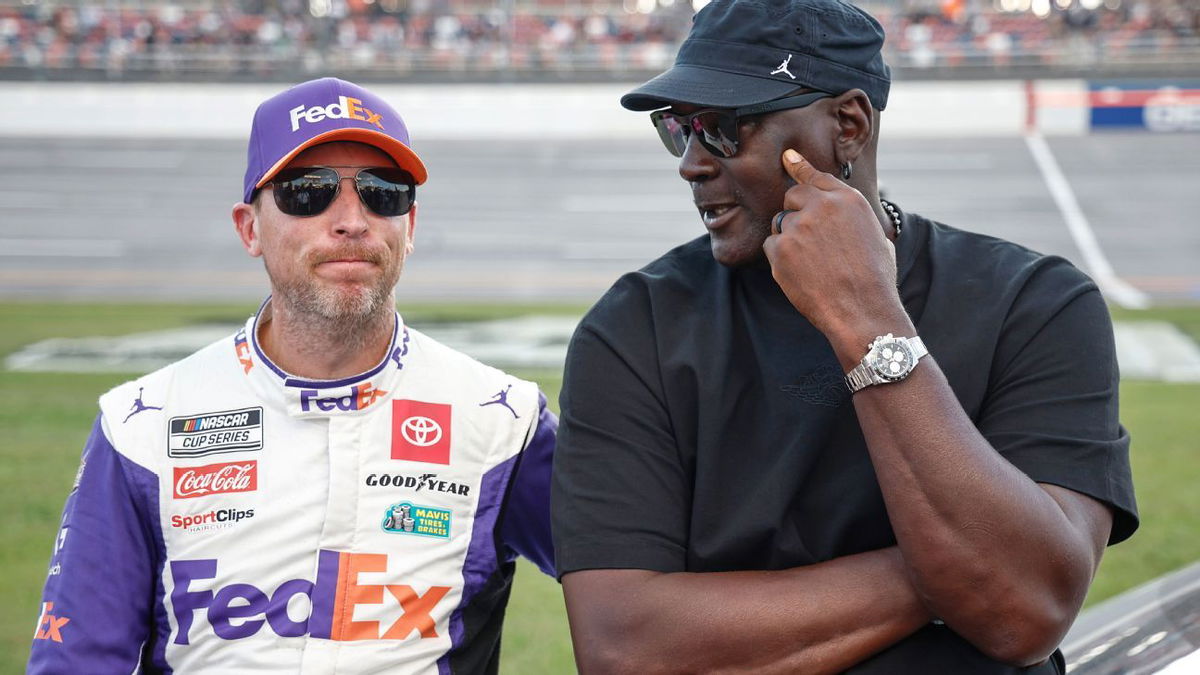
For months now, 23XI Racing co-owned by Michael Jordan and Denny Hamlin, and Front Row Motorsports have accused NASCAR of running a system stacked against smaller or mid-tier teams, one that treats chartered teams like guaranteed franchises and “open” or non-chartered teams like expendable math problems.
Watch What’s Trending Now!
The two clubs refused to sign NASCAR’s 2025 charter agreement and, in October 2024, filed an antitrust lawsuit in federal court alleging that NASCAR’s rules and structure amount to a monopoly, hurting competition and profitability.
Opening arguments began December 1, 2025, in Charlotte, and that’s when Hamlin — 23XI’s frontman on the stand — delivered a stark assessment: running a Cup car for an entire season costs about $20 million just to compete, excluding overhead and driver pay. For many teams, especially those stuck outside guaranteed charters, that math simply doesn’t add up anymore.
ADVERTISEMENT
Denny faces the music
In the courtroom’s early hours, external counsel for NASCAR, Lawrence Buterman, aimed the financial claims set forth by 23XI and Front Row. One bombshell figure rattled the room: the teams are asking for $205 million in damages, a number Buterman characterized as a “900% return on investment” compared with what 23XI reportedly put in. That framing wasn’t subtle; it was meant to challenge the credibility of the whole demand under antitrust law.
When questioned directly about whether that 900% ROI was “fair,” Denny Hamlin was put on the spot. Under cross-examination, Buterman pressed him hard: could the public trust what he was saying, given that Hamlin admitted in past public statements to sometimes using “NASCAR talking points”? Hamlin pushed back firmly, calling the suggestion “nonsense.” The tension in the courtroom was instant and palpable.
ADVERTISEMENT
In the same hearing, Hamlin revealed another detail many fans may not have considered: his salary from his previous longtime team was around $14 million annually. That admission fed into a broader narrative; this isn’t just a dispute about charters or payouts, but about who truly bears the financial burden in Cup racing.
For NASCAR and its defense team, this is the moment to shrink the lawsuit’s headline numbers and shift the focus back to what they say is fair market business. Their argument hinges on the idea that guaranteed chartered payouts and the charter system itself protect teams’ value and ensure stability, not monopoly abuse.
ADVERTISEMENT
But with 23XI and Front Row arguing that many teams still can’t profit under current terms, the court may be asked to reconsider whether the system actually works for everyone.
Beyond the money, the emotional weight of the case has become impossible to ignore. That testimony has helped reinforce the teams’ broader claim: changes are not just needed, they are long overdue.
If 23XI and Front Row succeed in proving that NASCAR’s structure is anti-competitive, the consequences could be seismic: from changes to the charter system to restructuring revenue sharing, or even hitting the sanctioning body with massive damages. Individual teams’ bottom lines, long-term viability, and the balance of power in the Cup could shift dramatically.
ADVERTISEMENT
Right now, though, NASCAR’s legal team is working to undercut the lawsuit’s emotional and financial power, arguing that chartered status already delivers value, and that the $205 million demand is exaggerated and speculative. The “900% fantasy” line is their strongest weapon, a phrase calculated to force the jury to question just how real the losses are.
As the trial continues, all eyes are on the courtroom and beyond it, on what becomes of the sport. Because if the verdict goes in favor of 23XI and Front Row, the ripple effects could reshape NASCAR’s financial and competitive structure for a generation.
ADVERTISEMENT
ADVERTISEMENT
ADVERTISEMENT
