
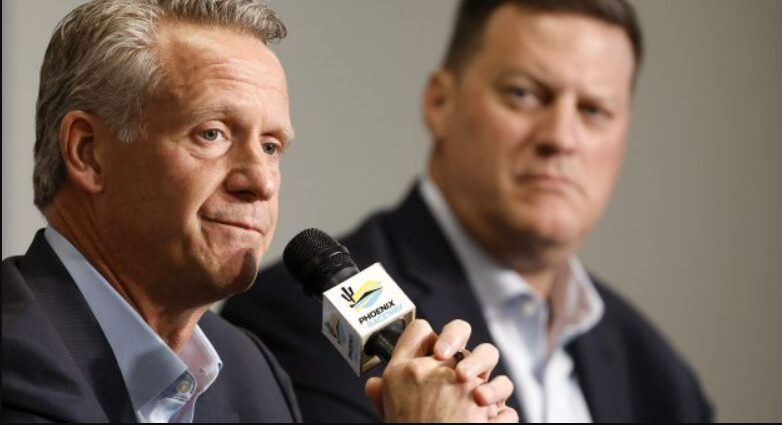
NASCAR is having a hard time putting people in the seats this year, and it’s starting to show. Races that once sold out without question are no longer doing so, and Phoenix Raceway quietly joined that list, marking its first non-sellout weekend since 2019. Empty grandstands have sparked a bigger question that the sport cannot dodge anymore. Are fans getting enough value for what they are paying? One NASCAR insider doesn’t think so, and he is pointing a finger straight at the top brass.
Watch What’s Trending Now!
Kenny Wallace deems NASCAR schedule the culprit
Kenny Wallace has stepped in to play the white knight for the NASCAR community. Speaking on his Coffee with Kenny segment on X, the 62-year-old veteran didn’t hold back.
ADVERTISEMENT
“Steve O’Donnell, my dear friend, if you’re listening to this, ‘You are the president of NASCAR. Let’s get some practice in on Friday and Saturday. Let’s do some things. Let’s give, let’s give these, these fans a reason to get to the racetrack early.'”
While entry-level tickets at some races still start in the $40-$60 range, average prices for decent grandstand seating have climbed noticeably, with many tracks listing regular seats closer to $80-$100.
Premium events such as the Daytona 500 remain in a separate category altogether, where prices regularly exceed $100 before fees. Compared to the mid-2010s, when many races could be attended comfortably for under $70, the cost of attending even a single race weekend has increased enough to force fans to be more selective.
ADVERTISEMENT
But more than the cost, it’s about the unpredictable schedule.
“Coffee with Kenny”
1- restaurant smells
2- I am NOT a journalist.
3- Are @NASCAR ticket prices to high ? pic.twitter.com/rIiiCU7831— Kenny Wallace (@Kenny_Wallace) December 31, 2025
ADVERTISEMENT
In recent seasons, the cup series has moved most practice and qualifying activity into tight Saturday windows, often splitting limited 25-minute sessions between small groups of cars and tightly sandwiching practice into the late afternoon or early evening rather than spreading on-track action across Friday and Saturday.
The effect has been a far smaller weekend presence of cup cars on tracks for fans to watch outside the main race, a pattern that many fans see as a departure from the old multi-day format that once defined a full race weekend experience.
For fans who make the trip to events, especially those who camp or stay for the full weekend, that tight schedule can feel like less value for their money and less incentive to show up early.
ADVERTISEMENT
This shift could have contributed to lighter Friday and even Saturday afternoon attendance at some races as spectators choose to arrive later or skip weekend passes entirely rather than pay full price for limited activity.
And Wallace knows exactly why.
“So back in the day. Say, I don’t know, 15 years ago? When you went to the racetrack, you had a reason to get there on Thursday night. Now my track owner says that’s why. The camping grounds are not packed anymore,” he added. “Because Cup practices at 4:30 on Saturday. Right now. And the times change for everything. Nothing’s consistent. Nobody knows what the f— is going on.”
ADVERTISEMENT
And with NASCAR’s history of not being able to see the very clear and visible answers at the right time, according to Dale Jr., they’d better be listening in close for this one. However, ticket prices are just one of the many reasons NASCAR may have gone wrong; Wallace has another reason lined up.
Top Stories
Greg Biffle’s $4M Worth Prized Possession Still Without a Buyer Leaves NASCAR Fans Heartbroken

NASCAR World Mourns as Former Watkins Glen President Michael Printup Passes Away at 60

Fox Broadcaster Pens Heartfelt Message as Veteran Announcer Quits NASCAR
Denny Hamlin Offers First Words Since Losing Beloved Father in Anniversary Fire

“This Is Not Racing”: Growing Outrage Erupts Over How Kids Are Being Taught to Win at Any Cost in Modern Motorsports
Wallace rants about track expansion and loss of short tracks
Kenny Wallace pushed the conversation about NASCAR’s direction back to the decisions that have shaped the sport over the past two decades, arguing that their impact is only now being fully acknowledged.
ADVERTISEMENT
“The first thing NASCAR did badly was they built too many big mile-and-a-half racetracks,” Wallace said. “We had the perfect tracks. We had Atlanta, we had Rockingham, and then all of a sudden they said, ‘We’ve got such a big crowd, we need more seats,’ so they built bigger racetracks.”
He pointed first to the sport’s heavy focus on mile-and-a-half tracks, which he believes came at the expense of more compelling races. According to Wallace, that shift led to the loss of tracks that fans connected with most.
“They got rid of Rockingham. They got rid of Wilkesboro,” Wallace added. “They left the tracks that were exciting, where you get into each other, where the fans recognized it, and they were on their feet.”
ADVERTISEMENT
With all this set in place, it can be said with much certainty that NASCAR definitely has a lot to learn from, and 2026 not only brings in the new year but also sets new expectations.
ADVERTISEMENT
ADVERTISEMENT
ADVERTISEMENT
